Friday, March 29, 2024

The Curious Case of Krishna's Missing Ring:

A Playful Leela In the vibrant tapestry of Vrindavan, where love bloomed like wildflowers and the Yamuna flowed with the music of devotion, resides a charming tale of Lord Krishna and his beloved Radha. This isn't a story of grand battles or cosmic pronouncements, but a playful leela (divine act) that reveals the depths of their connection. One idyllic afternoon, as Krishna frolicked with Radha and the Gopis (milkmaids) by the Yamuna's glistening banks, a glint of mischief sparkled in his eyes. Adorned with a magnificent jeweled ring, a gift from Radha perhaps, Krishna playfully teased the Gopis, his laughter echoing through the meadows. Suddenly, with a flick of his wrist, the ring slipped off his finger and tumbled down a grassy knoll. 


The Gopis gasped, but Krishna simply grinned. "Fear not, my friends," he declared, his voice brimming with amusement. "This ring holds no power for me compared to the joy of your company." Despite his nonchalance, a playful search ensued. The Gopis, their love for Krishna boundless, eagerly sifted through the vibrant green, their laughter mingling with the chirping birds. Radha, her eyes filled with concern and a hint of playful worry, joined the search. But the ring remained elusive. Had it rolled into a hidden crevice? Or perhaps, carried away by a playful breeze?

 Krishna, observing their endearing efforts, decided to extend the leela. With a mischievous twinkle, he revealed a blade of grass, its tip curled into a perfect ring shape. "Behold!" he exclaimed, his voice laced with amusement. "Nature itself has crafted a ring worthy of your love." Radha, her lips curving into a smile, accepted the grass ring. In that moment, it wasn't the jewel-encrusted ornament they sought, but the depth of their connection that truly mattered. The charade of the lost ring served as a reminder that true love finds joy in the simplest of things, in shared moments and playful exchanges. This leela of Krishna's missing ring exemplifies the essence of JKP (Jnana, Karma, Bhakti) and JKYog. It highlights the importance of: Jnana (Knowledge): 

If you want to hear the leela you can click the link 
Recognizing the impermanence of material possessions and the true value of love and connection. Karma (Action): The Gopis' selfless act of searching for the ring reflects the importance of service and devotion. Bhakti (Devotion): The playful exchange between Krishna and Radha underscores the joy and lightness found in pure devotion. Through this enchanting tale, we learn that love transcends material objects. It's in the playful moments, the shared laughter, and the unwavering devotion that true connection flourishes.

Why should you offer food to God before eating?


The food is cooked with the consciousness that it is for the pleasure of God and not for the sole purpose of gratifying our taste buds.

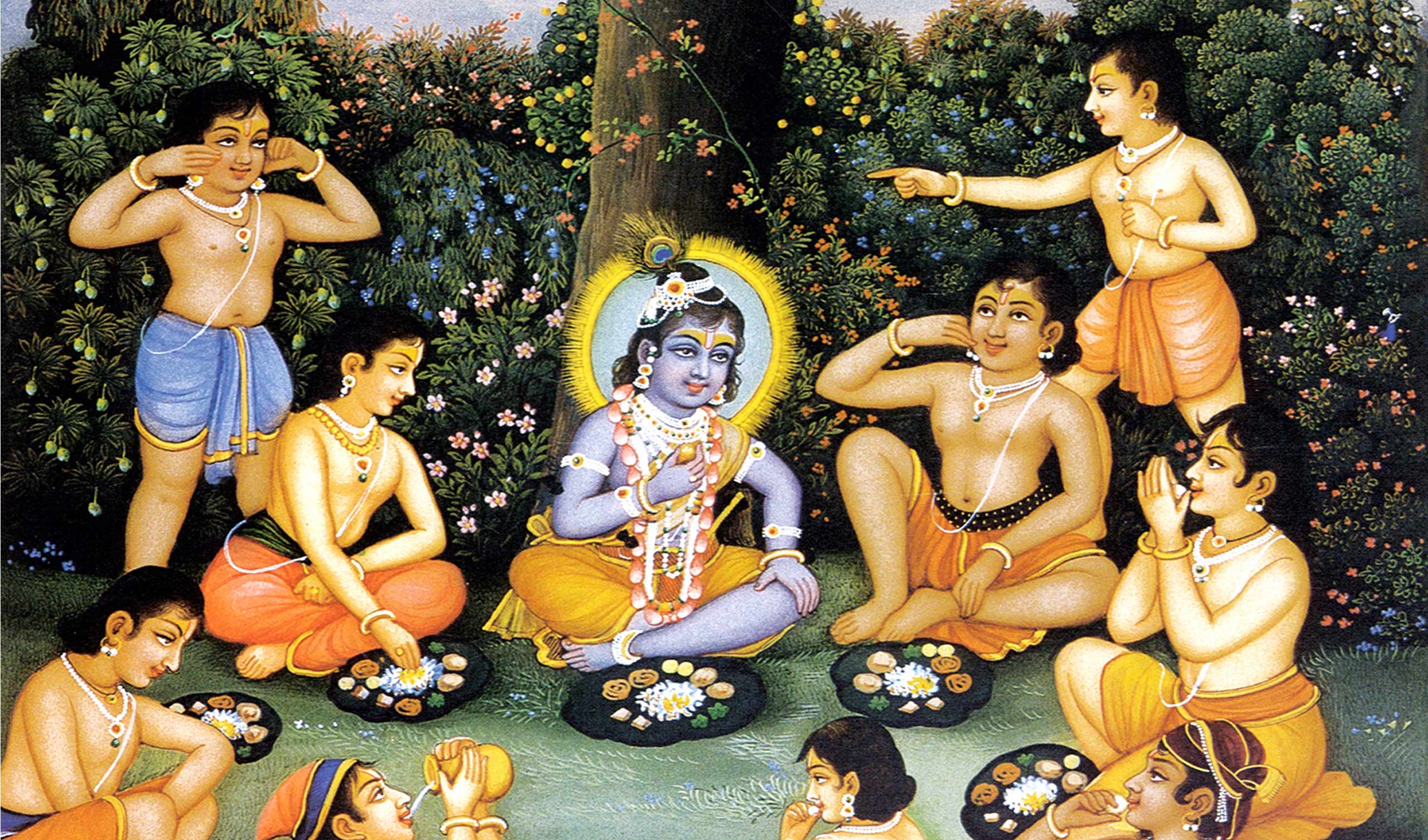
In the Vedic tradition, many people make prayers and offer food to God before eating. The food is cooked with the consciousness that it is for the pleasure of God and not for the sole purpose of gratifying our taste buds. A portion of the food items is then put in a plate and a verbal or mental prayer is made for the Lord to come and eat it. After the offering, the food on the plate is considered prasād and is accepted as God’s grace. 

Shree Krishna stated in the 13th Verse of Bhagavad Gita, Chapter 3:

यज्ञशिष्टाशिन: सन्तो मुच्यन्ते सर्वकिल्बिषै: |
भुञ्जते ते त्वघं पापा ये पचन्त्यात्मकारणात् ||

yajña-śhiṣhṭāśhinaḥ santo muchyante sarva-kilbiṣhaiḥ
bhuñjate te tvaghaṁ pāpā ye pachantyātma-kāraṇāt


The spiritually-minded, who eat food that is first offered in sacrifice, are released from all kinds of sin. Others, who cook food for their own enjoyment, verily eat only sin.

Other religious traditions follow similar customs. Christianity has the sacrament of the Eucharist, where bread and wine are consecrated and then partaken. It is simple, whatever we eat has to be first offered to God.  Eating food offered to God changes our consciousness. It not only nourishes the body it also nourishes our soul.

The question may arise whether we can offer non-vegetarian items to God and then accept the remnants as his prasād. The answer to this question is that the Vedas prescribe a vegetarian diet for humans, which includes grains, pulses and beans, vegetables, fruits, dairy products, etc.

Apart from the Vedic culture, many spiritually evolved souls in the history of all cultures around the world also rejected a non-vegetarian diet that makes the stomach a graveyard for animals. Even though many of them were born in meat-eating families, they gravitated to a vegetarian lifestyle as they advanced on the path of spirituality.

According to Leonardo da Vinci:

Truly man is the king of beasts, for his brutality exceeds them. We live by the death of others. We are burial places! I have since an early age abjured the use of meat…

In fact, in the Bhagavad Gita Shree Krishna goes a step further and states that even vegetation contains life, and if we eat it for our own sense enjoyment, we get bound in the karmic reactions of destroying life. However, if we eat food as remnants of sacrifice offered to God, then the consciousness changes. We then look at our body as the property of God, which has been put under our care for his service. And we partake of permitted food, as his grace, with the intention that it will nourish the body.

We understand how food affects our body but we often overlook its impact on the mind.  Vedas say, what we eat is what our body and mind are made of.

Who Am I ?

 Continuing our short series on ‘Who Am I’, let us now understand the characteristics of the soul.  Scriptures talk about two types of characteristics; Svaroop and tatastha (marginal) characteristics. Svaroop means the natural characteristic of the soul.  The soul is conscious; it is a power of God. At the same time, the Darshan Shastra as well as the Kenopanishad  point out that the entity called ‘I’ is beyond the intellect, and as such, it cannot be understood by the intellect. The ‘I’ is beyond the grasp of the senses, the mind and the intellect since these are material and non-conscious.

Ved-Vyas says in Vishnu Puran that God has three main powers.  The first is para shakti, the second is kshetrajna shakti (tatastha or marginal) and the third is called mayaPara shakti is God’s own personal power.  It is also called as Svaroop shakti or Yogmaya shakti. God’s marginal power (tatashta) refers to the individual soul.   God’s external power is called avidya, i.e. maya.  What function does avidya perform?  It creates the world.  Maya includes God’s power ‘maya’ as well as the world.  So, there are three powers – Yogmaya, Maya and the individual soul.

The individual soul is a fraction of God.  It is the marginal power of God (tatastha shakti).  What is the marginal characteristic of the soul?  It is an eternal servant of God.

Lord Chaitanya Mahaprabhu says,

The soul’s true nature is God’s servitude

The Puranas, Shastras and God-realized saints say the same thing. The Vedas, the Shastras and the saints, say that there is a difference as well as a ‘non-difference’ between God and the individual soul.  It is a very unique relationship indeed.

God is conscious, and so are we.  From this point of view, we are equal to God.  But there are differences between God and the individual soul. God is unlimited consciousness and we possess limited consciousness.  In other words, God’s consciousness pervades everything, and our consciousness pervades only our own body.  The soul pervades a small body; that of an ant, and it pervades a big body, that of an elephant.  There is no body bigger than that. God is omnipresent; He is unlimited consciousness, and the individual soul is very small, very subtle.

How small is the soul?  The very definition of the soul is that it is the smallest. Every Veda and Shastra says that the soul is so small that there is nothing smaller.  Thus, God is unlimited consciousness and the soul is minute consciousness.  This is a very big difference indeed.  Let us look at the second difference.  God is the controller; the individual soul is controlled.


Saturday, February 24, 2018

धरो मन ! गौर - चरन को ध्यान |

धरो मन ! गौर - चरन को ध्यान |
जिन चरनन को राखत निज उर, सुंदर श्याम सुजान |
भटकत कोटि कल्प तोहिँ बीते, खायो सिर पदत्रान |
चार प्रकार लक्ष चौरासी, द्वार फिर् यो जनु स्वान |
चरण - शरण कबहूँ नहिं आयो, अबहूँ करत न कान |
येहि दरबार दीन को आदर, पतितन को सनमान |
पुनि ‘कृपालु’ तुम कत चूकत मन, पंडित बनत महान ||


भावार्थ - अरे मन ! कीर्ति - कुँवरी राधिका जी के चरणों का निरन्तर ध्यान किया कर, जिन चरणों का ध्यान सच्चिदानंद श्रीकृष्ण भी करते हैं | अरे मन ! तुझे भटकते हुए अनन्त जन्म बीत चुके, एवं तूने उन विषयों के अनन्त बार जूते खाये | स्वेदज, अंडज, उद् भिज, जरायुज इन चार प्रकार की उत्पत्ति के द्वारा कुत्ते की तरह तूने चौरासी लाख योनियों में चक्कर लगाया है, किन्तु किशोरी जी के चरण - कमलों की शरण कभी नहीं ली | आज भी मेरी बात नहीं मान रहा है | अरे मन ! किशोरी जी के दरबार में पतितों एवं दीनों को ही सम्मान मिलता है | ‘श्री कृपालु जी’ कहते हैं कि अरे मन ! तुम बहुत बड़े पंडित बनते हो फिर ऐसा अवसर क्यों खो रहे हो, अर्थात् किशोरी जी के चरणों की शरण क्यों नहीं लेते ?
( प्रेम रस मदिरा सिद्धान्त - माधुरी )
जगद्गुरु श्री कृपालु जी महाराज द्वारा रचित
सुखमय, मंगलमय व् भक्तिमय रविवार की शुभकामनाओं के साथ
🙏🙏 राधे राधे 🙏🙏

Monday, July 23, 2012

Look at the grandeur of the month of Shrawan, O Sakhi !


देखु सखि! सावन मास बहार।
नवल निकुंज-मंजु बिच झूलत, नवल युगल सरकार।
पकरे दोउ, इक-इक कर डोरिन, इक-इक कर गर डार।
दोउ देँ झोँटे झूमि-झूमि झुक‌ि, एकहिं एक निहार।
फहरत नील पीत पट अंचल, चंचल लट घुँघरार।
गावत राग मलार दुहुँन मिलि, अलि कर स्वर-विस्तार।
सखिन बजावति बीन वेनु कोउ, सब प्रवीन इक-सार।
लखि कृपालुकह दोउ मम ठाकुर, जय हो जय बलिहार
  

            Look at the grandeur of the month of Shrawan, O Sakhi !
        Radha and Krishna are enjyoing the swing in a Kunj
They both are embracing each other with one hand and holding the swing with other
Radha and Krishna are overjoyously swinging and smiling and looking at each other
Yellow dress of Shree Krishna and Blue dress of Radharani are swaying so are their shiny black curly hair
Taking melodious taan in high pitch tone, they are singing a loving song in a very sweet voice
To exhilarate the Bliss of the leela, Sakhis are playing different musical instruments in perfect taal
Looking at this beautiful pastime, Shree Kripaluji Mahraj says- All Glories to my Divine Couple of Radha-Krishna!!

Monday, June 25, 2012

My Beloved is Shree Krishna of Vrindavan


Our Ishta dev (the chosen form of God we worship) is Shree Krishna, who performs sweet pastimes in the groves of Vrindavan.  It is natural to be curious as to why one should accept Kunj Bihari Shree Krishna as one's Ishta dev?
Let us consider whom all we can be devoted to and make as our Ishta dev.  It can be human beings, the celestial gods, demons or the Supreme Lord.  Amongst them, it is better to worship humans than to worship demons, who are in the mode of ignorance.   Better than just any human, is one's own mother, father, son, daughter, etc.  Better than them are the celestial gods like Indra, Varun, Kuber etc.  But, all these three kinds of personalities are under the influence of Maya.  If we worship any of these as our Ishta dev, the result will be endless wandering in the cycle of 8.4 million species of life.  We will neither get rid of sorrows and pain, nor attain eternal happiness.  These divine goals will only be attained if we make some Divine personality as the object of our worship. 
Now, in the spiritual realm, whom can we consider as our Ishta dev?  First is the impersonal, formless aspect of God, which possesses no qualities.  This impersonal aspect of God is chosen by the gyanis, who worship the attributeless Brahm.  However, in Kaliyug very rarely does anyone possess the qualification for worshipping the formless Brahm.  It requires hard spiritual practice and immense control over the mind.  Arjun, who was a master archer and had rejected even Urvashi, the celestial beauty, admitted in the Bhagavad Geeta:
chaṁchalaṁ hi manaḥ kṛiṣhṇa pramāthi balavaddṛiṛham |
tasyāhaṁ nigrahaṁ manye vāyoriv suduṣhkaram  ||
"O Shree Krishna! This mind is very unsteady and wavering.  I have been defeated by its flickering nature.  Its speed is faster than air."  God replied, "Yes Arjun, You are right.  However, with the selection of the correct path and surrender to the right form of God, we can attain our goal."  Arjun replied, "There are two aspects of God - Impersonal or Formless and Personal.  Whom should we make our Ishta dev, or chosen form of God for worship?"  Shree Krishna answered, "Arjun! For humans to follow the path of gyan and meditate on the formless Brahm is impossible."  Tulsidas ji clearly stated:
kahat kaṭhin samujhat kaṭhin sādhan kaṭhin vivek |
hoy ghuṇākṣhar nyāy jo puni prayooha anek ||
"The path of gyan is difficult both to explain and to understand.  To practice it is even more difficult.  It is next to impossible to attach the mind the formless God, Brahm as our ishta dev.  And if by chance we make Brahm as our ishta dev, then the final result of this practice, Brahmanand (the Bliss of the formless Brahm) is inferior compared to the Bliss of the personal form of God.
The scriptures say that even if we add seventeen zeros next to one, and multiply that with Brahmanand, it will not be equal to a tiny fraction of Premanand (the Divine Love Bliss of the personal form of God).  Such is the pleasure in the Divine Love Bliss of the personal form of God, Shree Krishna.
It is extremely difficult to worship the formless Brahm, as firstly one has to meet the strict criteria for entrance to the path of gyan. Secondly, the actual practice on the path is even more difficult.  And if someone starts following this path, it will stop at atmagyan, or the knowledge of the self. 
Hence, we do not have to consider Brahm as our chosen form of God for worship.  Now let us go higher than this.  Let us consider which Personal form of God we should choose as our Ishta Dev.  We have Maha Vishnu, who has four arms, and is also a Form of God.  He is known as the Lord of the Vaikunth abode.  He sits in a very serious mood.  The Mahapurushas, or Saints, of shant bhav worship Him.  The demons killed by Shree Krishna go to this abode.  Maha Vishnu neither performs any pastimes, nor has any associates.  The devotees only have His Divine vision.  They do not relish the Bliss of any leela.   Maha Vishnu is a form of Shree Krishna, but the Bliss in that form is less.  Sweeter than that is the Bliss of Shree Krishna in Dwarka.  There, the almightiness and opulence of God is slightly hidden.  But even there, the highest Bliss is not present.
In one pastime, Shree Krishna showed his Universal form to mother Yashoda.  She thought, "He is God. I am committing a sin by considering Him to be my son.  I scold Him, tie Him with a rope."  God noted her feelings.  God thought, "Now, mother really knows My identity.  What will happen? She will start worshipping me like others.  She will not consider my as her son."
vaiṣhṇavīṁ vyatanonmāyāṁ putrasnehamayiṁ vibhuḥ |
Shree Krishna called yogmaya, His personal power, and made mother Yashoda forget everything.  She then said, "What was I thinking?  I have become mad in my old age.  My memory has become weak.  He is my son, and nothing more than that."  She forgot that Shree Krishna is God.  Therefore, the Bliss of Vrindavan is the greatest of all.
In the abode of Braj, everybody including Shree Krishna's friends would forget that He is God.  They would play with Him, fight with Him and tease Him.  Everyday, the gopis abused Shree Krishna by calling Him a flirt and a loafer! This is how they used to address the Supreme Brahm! Shree Krishna would forget His Godliness and become their eternal servant.
In the material world, a woman always seeks a husband who will provide her the best comforts and keep her happy.  She wants an IAS officer or a millionaire.  If she doesn't find such a groom, that is a different issue.  And after getting married to that person, she gets sorrows and pain, that is again a different thing, but every girl has this dream and thinks that her husband should be the best and everybody should respect him.
Shree Krishna has many forms, but the one who performs loving pastimes in the groves of Vrindavan is the sweetest of all.  Hence, Shree Krishna from Vrindavan is the form of God we should worship.  Our Ishta dev should be that form of God which gives the highest Bliss.
Translation of lecture  delivered by Shree Maharajji

Saturday, October 29, 2011

If someone is doing wrong with me, should I practice forgiveness?


Question:  You teach us that we should increase our tolerance, but if someone is doing wrong with me, should I practice forgiveness, or should I oppose him and stop the atrocity? 

Answer:  On the spiritual path, we naturally learn to practice tolerance, forgiveness and humility. However, this does not mean that we should knowingly allow others to exploit us. The scriptures instruct us to take whatever action is necessary, for protecting ourselves in self-defense, when attacked. 
There is a charming story in this regard. In a neighborhood, there lived a venomous and foul-tempered snake. The children of that locality were scared of it to death. The moment they would spy it in the distance, they would run for their lives 
One day, Sage Narad Muni happened to come to that neighborhood. As was the snake's habit, he approached Narad ji, with his hood raised menacingly and eyes fiercely red. Narad ji stood his ground peacefully, with a benevolent and serene smile on his face. The snake was astonished. "Everyone runs from me in fear. How come you are not scared of me and what is the secret of your peacefulness?" 
Narad ji taught the snake the process of devotion, whereupon the snake became his disciple and began practicing Bhakti.  He shunned violence, giving up his old ways of scaring the neighborhood children. 
Soon the children came to know that the snake was harmless and did not bite anyone. Now their fear vanished. They would not leave it alone. On sighting it, they would bombard it with a battery of stones and sticks. They would even come close and kick it with their heeled shoes.  The poor snake was badly bruised.
One year later, Narad ji was visiting that area again. He thought, "Let me see how my disciple is doing." He was dismayed to see the snake badly bruised, with a plaster cast on a portion of his body. "What happened to you, my dear disciple?" he asked.
The snake replied, "O Gurudev, this is the result of the Bhakti that you taught me. The people of the world, knowing I will not retaliate, do not let me live peacefully." 
Narad ji said, "I asked you to stop biting people, but I did not ask you to stop spreading your hood.  Whenever the children attack, you should simply raise your head and hiss loudly; then no one will come near you." 
Henceforth, whenever the children came close to the snake, it would hiss loudly and frighten them all away. Soon, it was living peacefully again.  Similarly, on the path of devotion, we should shun actions and thoughts directed at harming others, but we definitely have the right to perform legitimate actions in our self-defense.